Module 1 of 6
Sky, Sun and the Origins of the Count
Where the count comes from: the movement of the sun and sky as observed from Mesoamerica, the cosmology of the Suns, and why a calendar was inseparable from astronomy and ceremony.
Lecture
What to take from this module
- The calendar is naked-eye, horizon-based astronomy: from a fixed point of observation you watch the sunrise travel north to south along the horizon across the year.
- Two interlocking counts run at once — a 260-day count of days (tonalpowalli) and a 365-day solar year (xiuhpowalli).
- Mesoamerican timekeeping is shared across peoples and centuries; the Mexika inherit and refine a very old system.
- Creation accounts of the Suns frame time as cyclical and renewable rather than a single line running from a beginning to an end.
Terms introduced
- Tonalpowalli
- The 260-day count of days: 20 day signs paired with the numbers 1–13.
- Xiuhpowalli
- The count of the solar year: 18 veintenas of 20 days plus the nemontemi.
- Tonalli
- Day, heat, warmth, destiny — the share of solar force a day carries.
Supplemental videos
The Aztec myth of the unlikeliest sun god — Kay Almere Read (TED-Ed)
Handout
PDF · printable
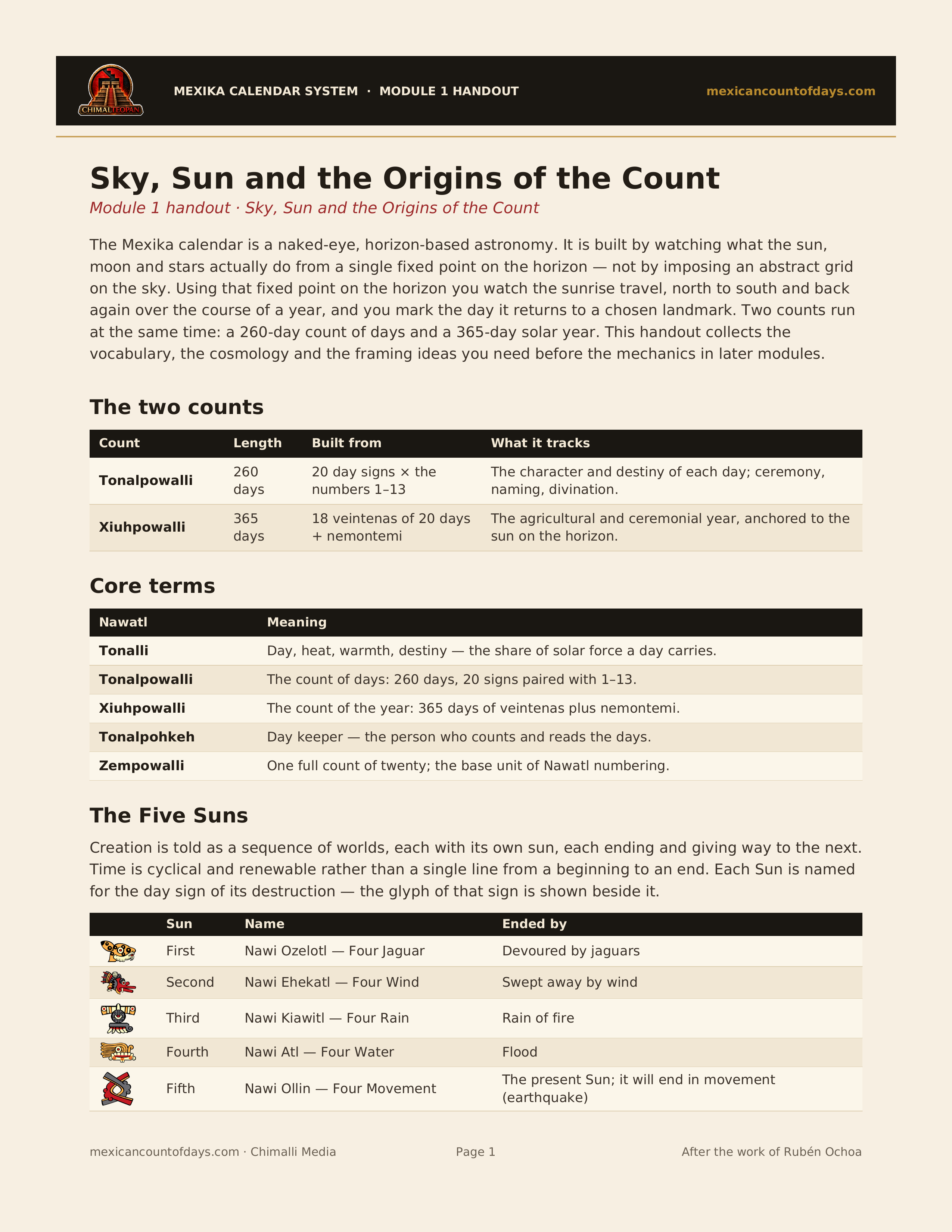
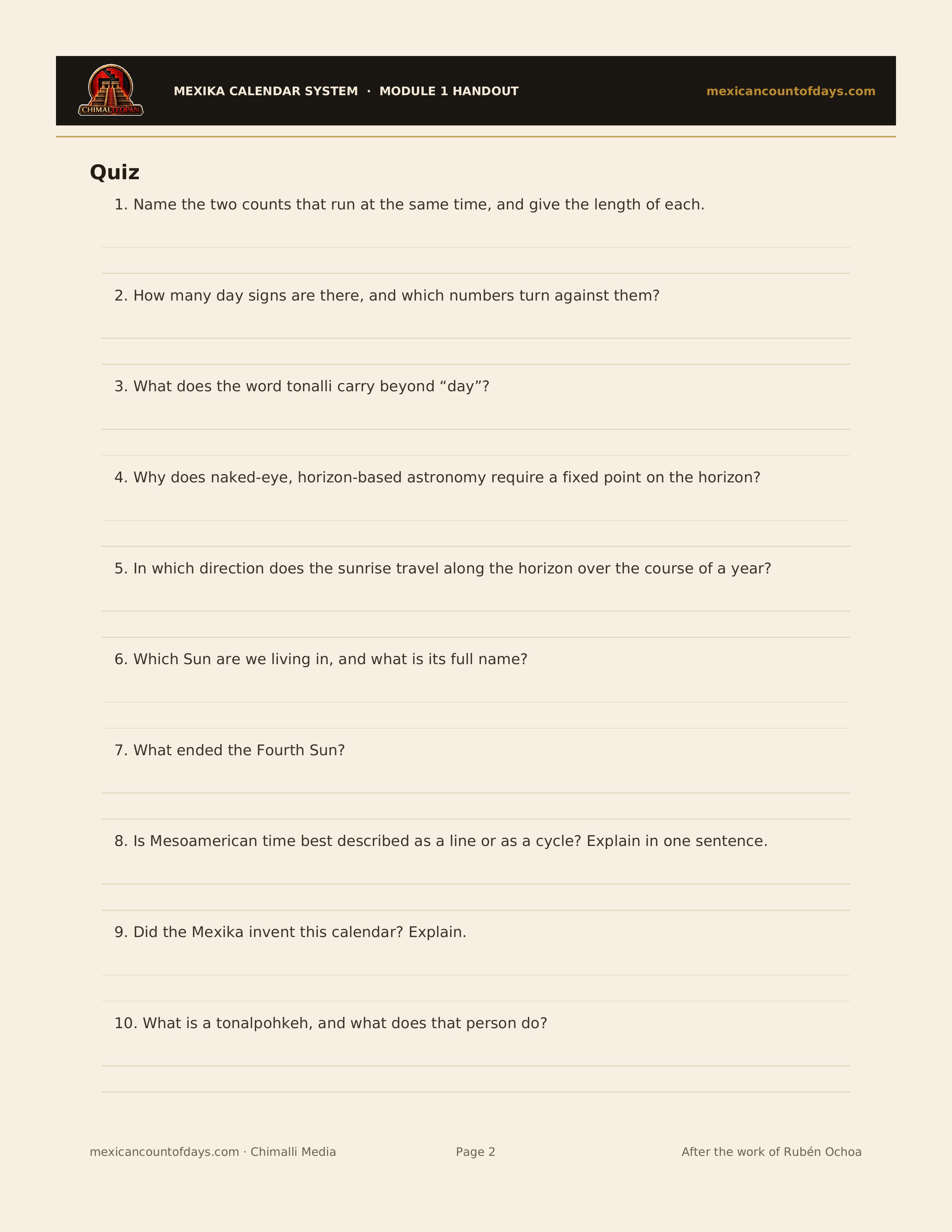
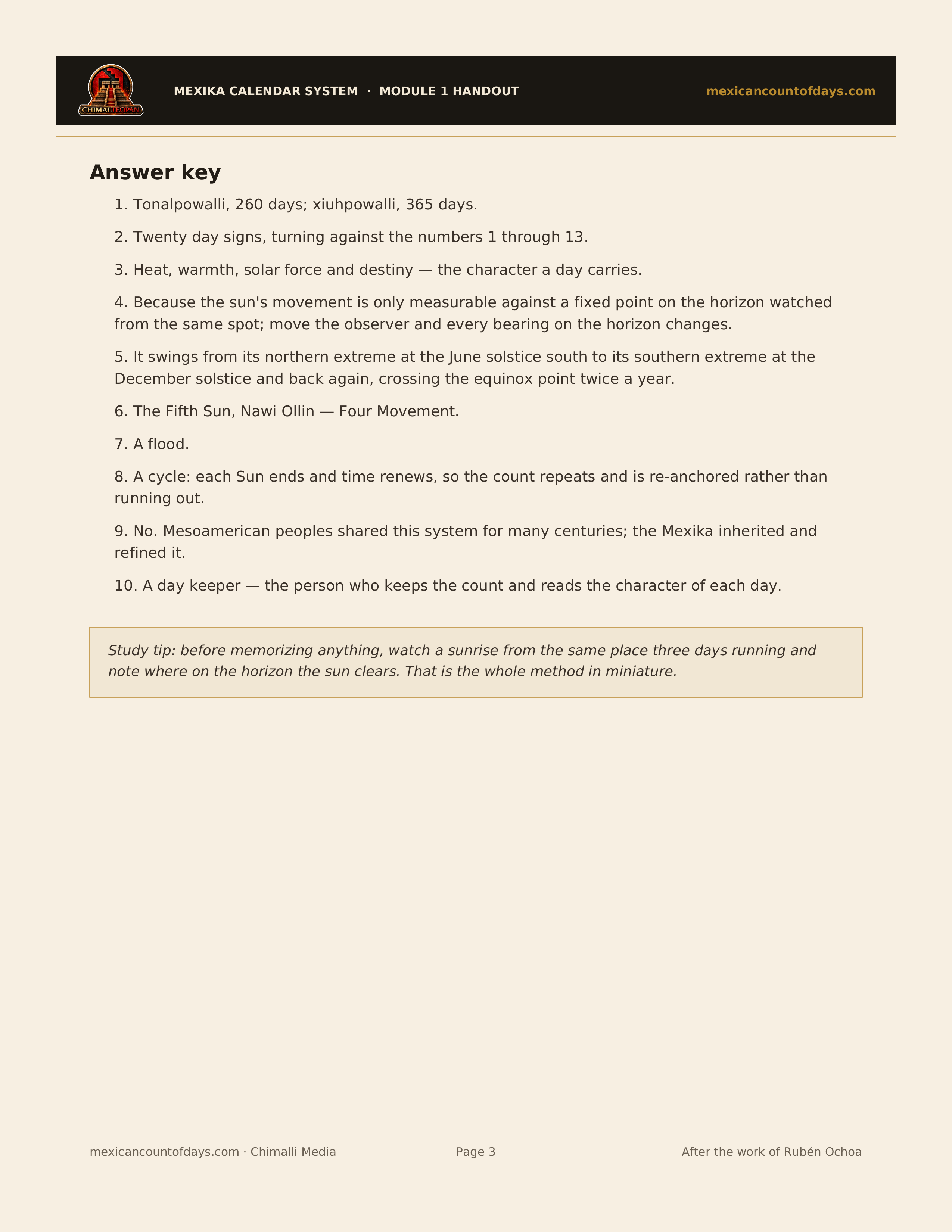
Handout: Sky, Sun and the Origins of the Count (PDF)
Printable reference with the two counts side by side, core Nawatl terms, the Five Suns, a ten-question quiz and answer key.
Additional readings
Finish the readings and supplemental videos before moving to the next module.
Checkpoint
- Can you name the two counts that run simultaneously, and the length of each?
- Why does an observational calendar require a fixed place of observation?
Cumulative exam · 6 questions
Module 1 exam
This exam covers Module 1 and everything before it. You need more than 90% correct to pass.
1.Why is the Mexika calendar described as an observational science?
2.Mesoamerican timekeeping is best described as:
3.Tonalli refers to which cluster of meanings?
4.The accounts of the Suns frame time as:
5.How many days are in the tonalpowalli?
6.What does xiuhpowalli count?