Module 2 of 6
Reading the Horizon: Alignments and the Templo Mayor
How architecture keeps time. Buildings at Tenochtitlan, Teotihuakan and across Mesoamerica were oriented to sunrise events on the horizon, turning cities into instruments for anchoring the year.
Lecture
What to take from this module
- Orientation is data: the azimuth of a temple records the day its builders wanted marked.
- The Templo Mayor of Tenochtitlan frames an equinox-season sunrise between its twin shrines — the anchor point for the solar year in this system.
- Construction stages show the alignment being maintained deliberately across rebuildings.
- Because the anchor is a sunrise observed at a place, the year begins at sunrise, not at midnight.
Supplemental videos
Supplemental Video to Module 2 — Chimalli Media
Etapas constructivas de Templo Mayor (INAH TV)
Equinox Sunrise — Temple of the Seven Dolls, Dzibilchaltún
Handout
PDF · printable
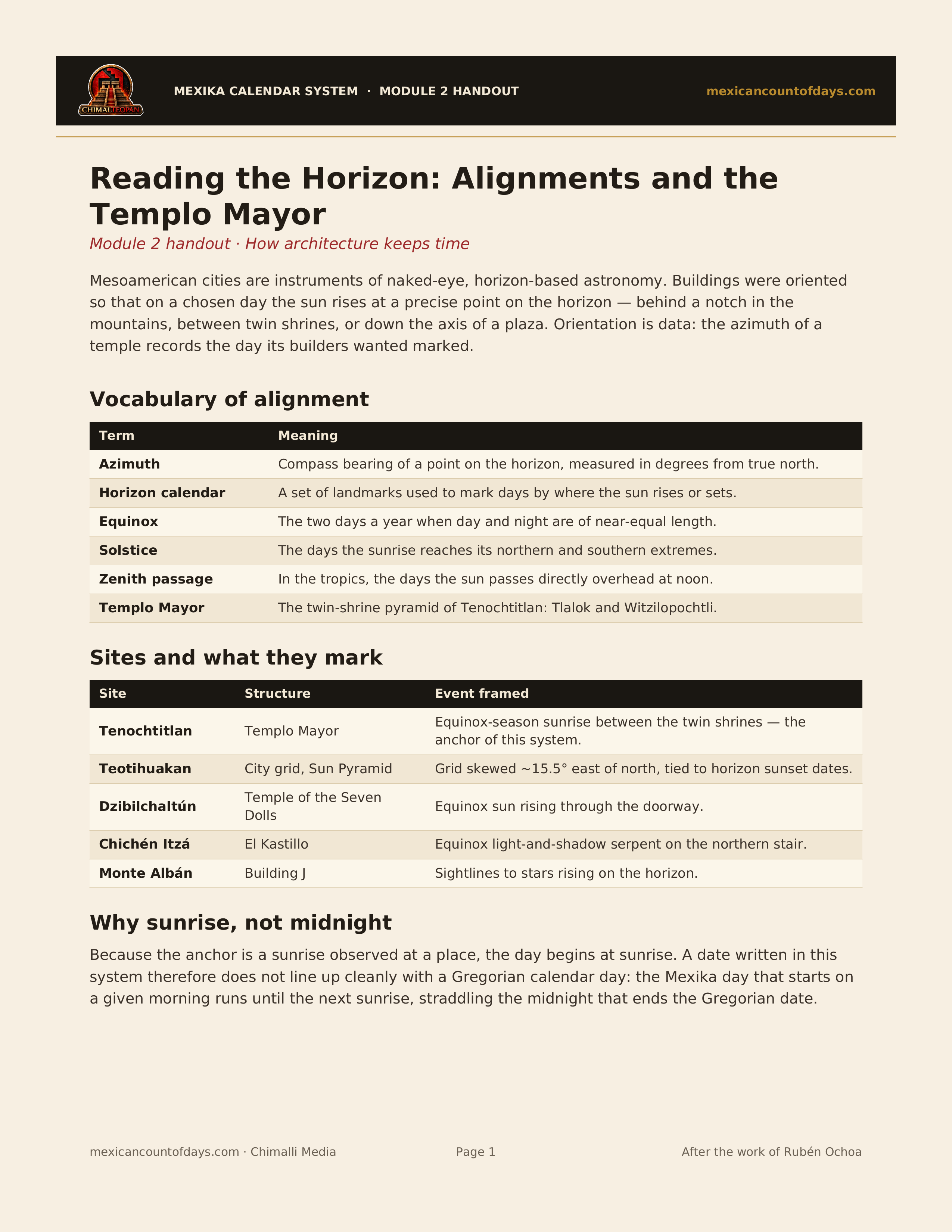
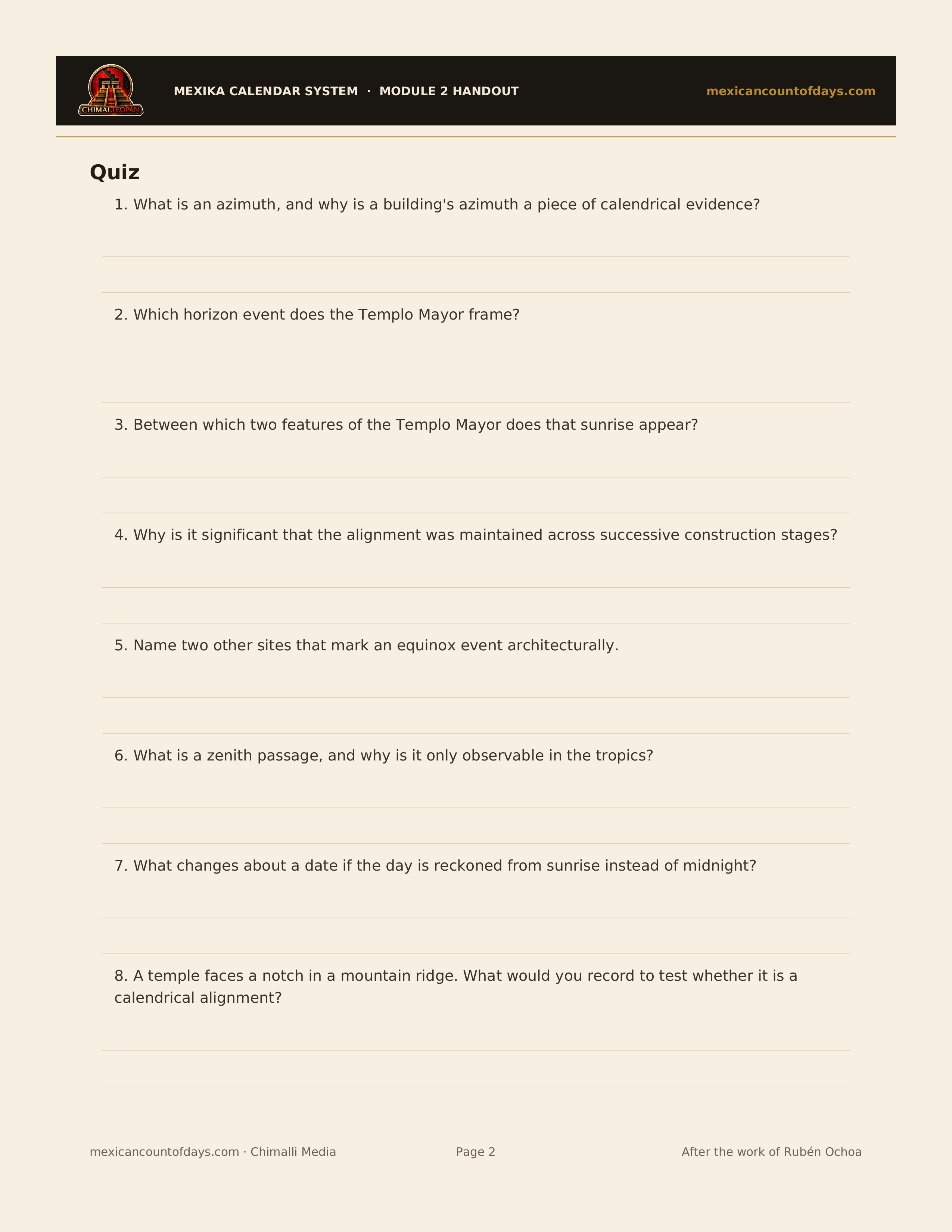
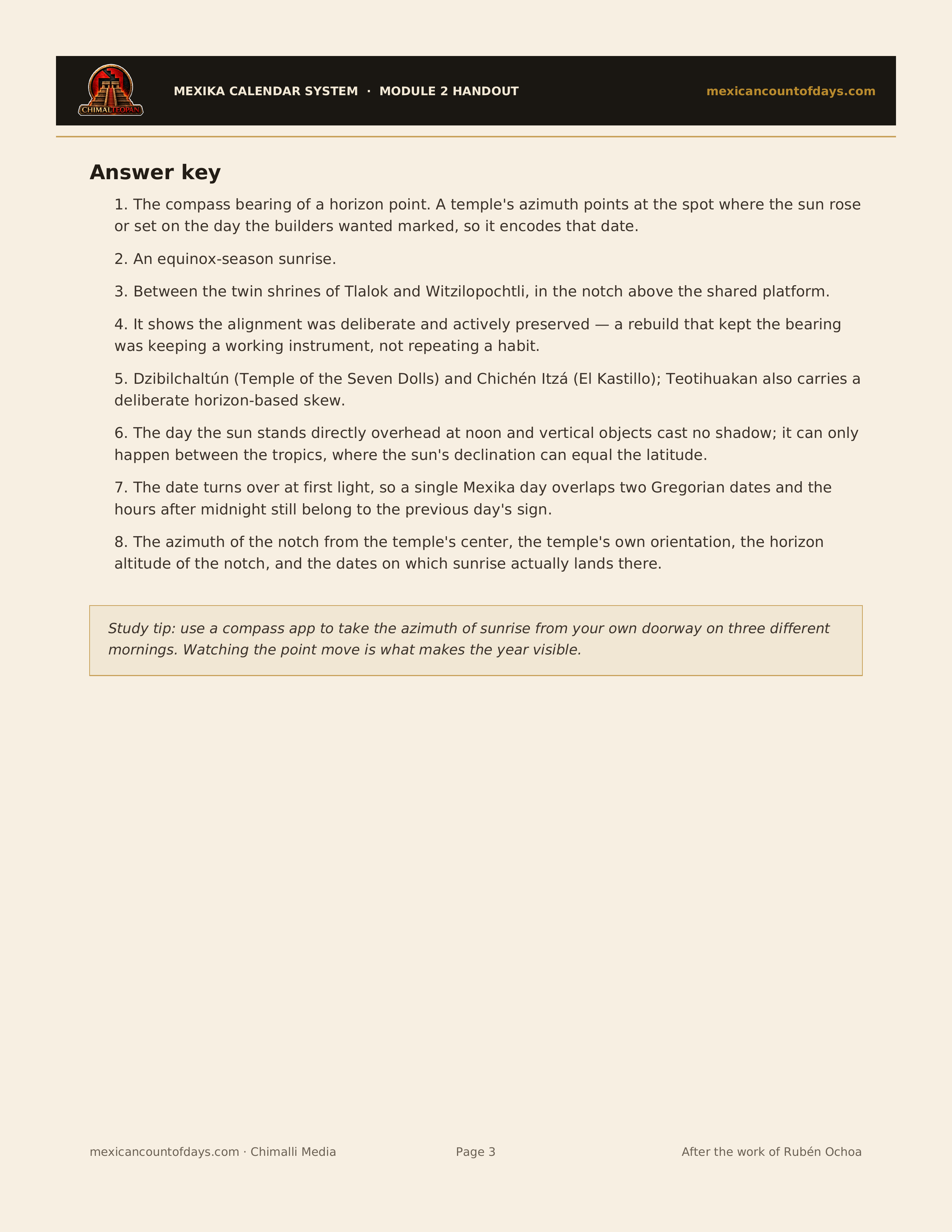
Handout: Reading the Horizon — Alignments and the Templo Mayor (PDF)
Vocabulary of alignment, a table of sites and the events they frame, why the day begins at sunrise, plus quiz and answer key.
Additional readings
- Suns, Moons, Clocks, and Bells: Native Americans and Time (PDF)
- On the Orientation of Precolumbian Buildings in Central Mexico (PDF)
Finish the readings and supplemental videos before moving to the next module.
Checkpoint
- Which horizon event does the Templo Mayor frame, and why does that matter for the count?
- What changes about a date if the day is reckoned from sunrise instead of midnight?
Cumulative exam · 11 questions
Module 2 exam
This exam covers Module 2 and everything before it. You need more than 90% correct to pass.
1.What does the orientation (azimuth) of a temple record?
2.Mesoamerican timekeeping is best described as:(Module 1 review)
3.What do the successive construction stages of the Templo Mayor demonstrate?
4.The accounts of the Suns frame time as:(Module 1 review)
5.The Templo Mayor of Tenochtitlan frames which event between its twin shrines?
6.Why is the Mexika calendar described as an observational science?(Module 1 review)
7.Buildings oriented to horizon events effectively turn a city into:
8.How many days are in the tonalpowalli?(Module 1 review)
9.What does xiuhpowalli count?(Module 1 review)
10.Tonalli refers to which cluster of meanings?(Module 1 review)
11.Because the anchor is a sunrise observed at a place, the Mexika day begins: