Module 3 of 6
The Count of Days: Twenty Signs, Thirteen Numbers
The engine of the system. Twenty day signs turn against the numbers 1 through 13, producing 260 unique days, thirteen-day trecenas, and the sequence recorded in the codices.
Lecture
What to take from this module
- 20 signs × 13 numbers = 260 days before any pairing repeats. Nothing is arbitrary about the length.
- Each block of thirteen days (a trecena) takes its character from the day sign that opens it; the number gives the strength of that influence.
- The codices — Borgia, Borbonicus, Telleriano-Remensis — are working documents of this count, not decoration.
- Day signs carry patrons and auguries; day keepers read them as testimony about the character of a day.
Terms introduced
- Trecena
- A run of thirteen days named for its opening day, e.g. 1 Kiawitl.
- Day sign
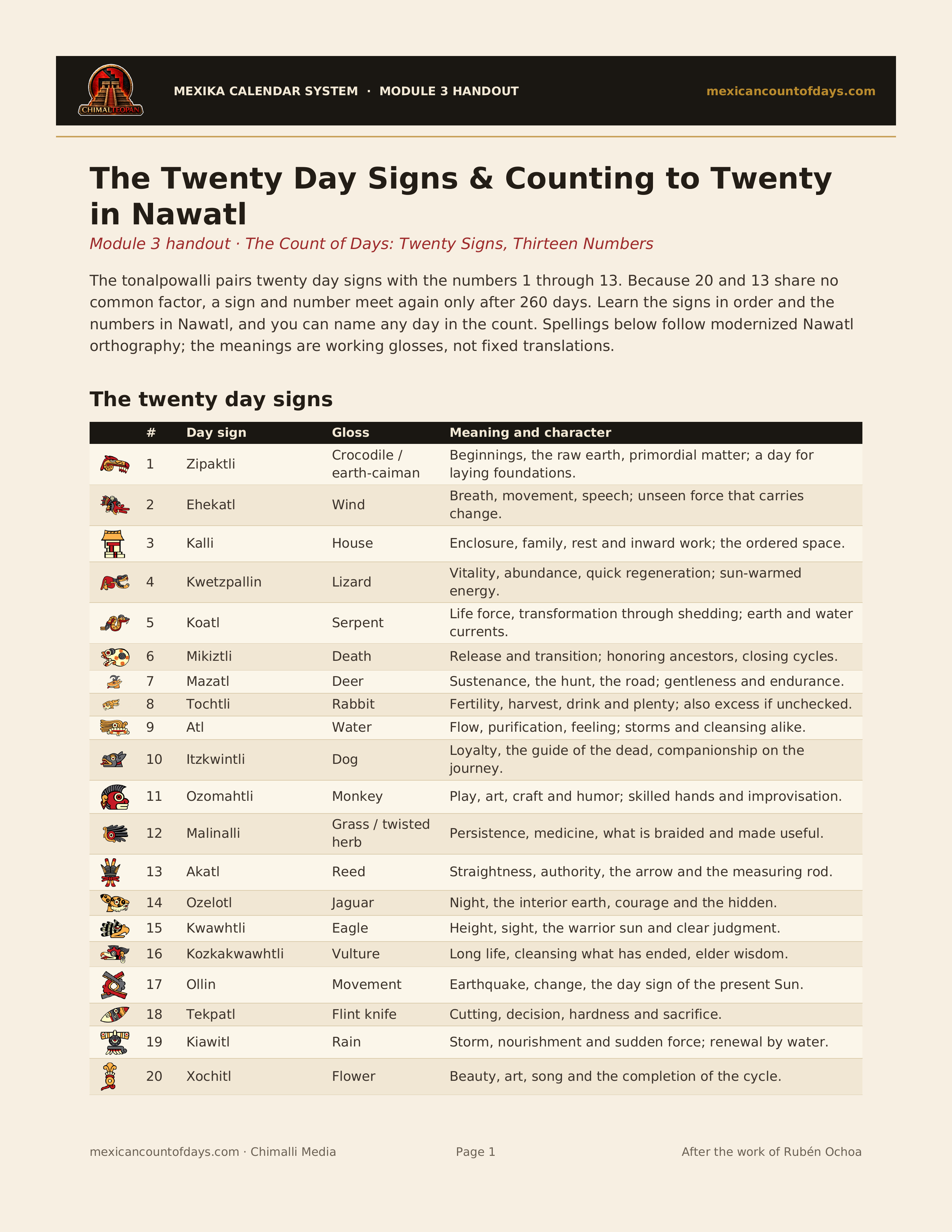
- One of the twenty: Zipaktli, Ehekatl, Kalli, Kwetzpallin, Koatl, Mikiztli, Mazatl, Tochtli, Atl, Itzkwintli, Ozomahtli, Malinalli, Akatl, Ozelotl, Kwawhtli, Kozkakwawhtli, Ollin, Tekpatl, Kiawitl, Xochitl.
Supplemental videos
The Teotihuacan Fire Ceremony | Native America | PBS
Handout
PDF · printable
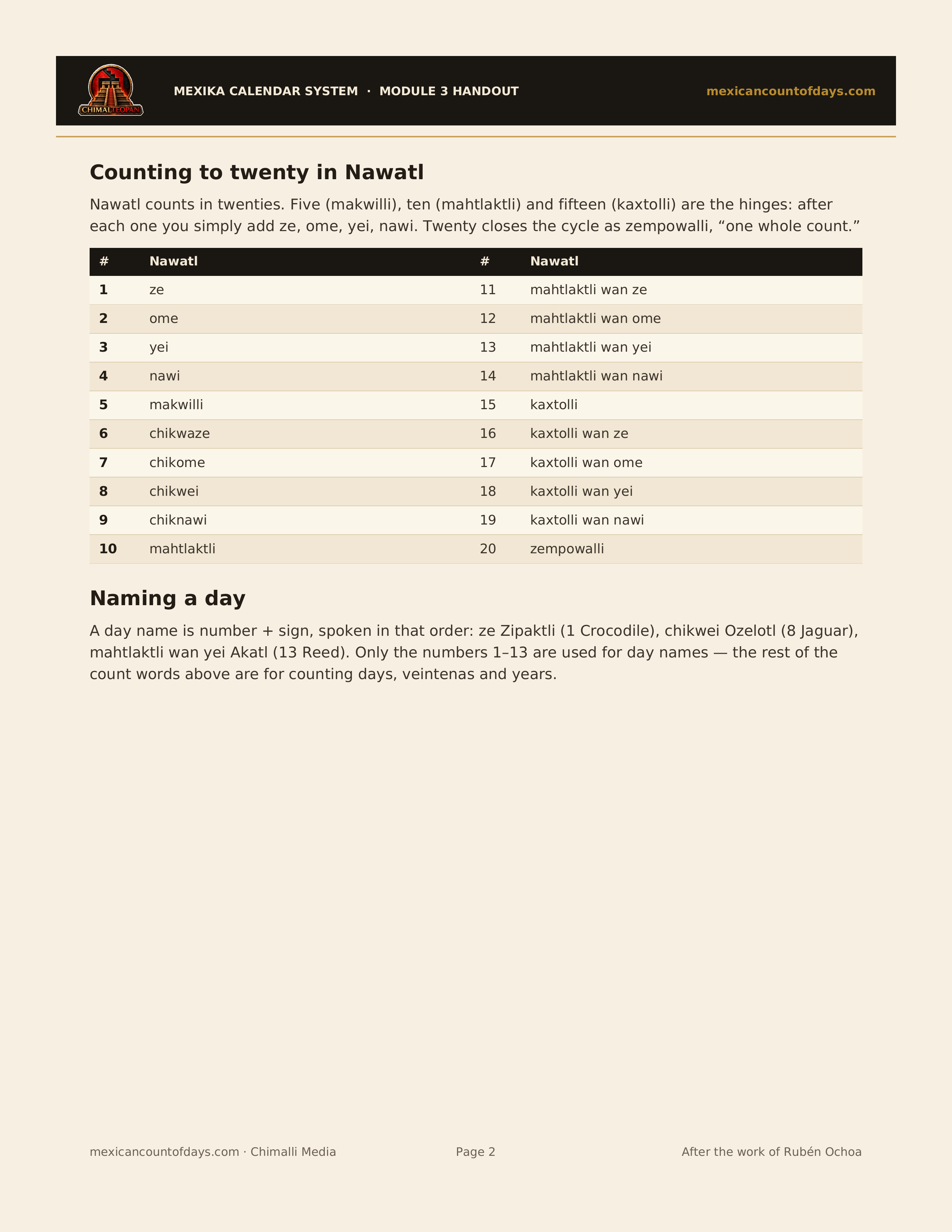
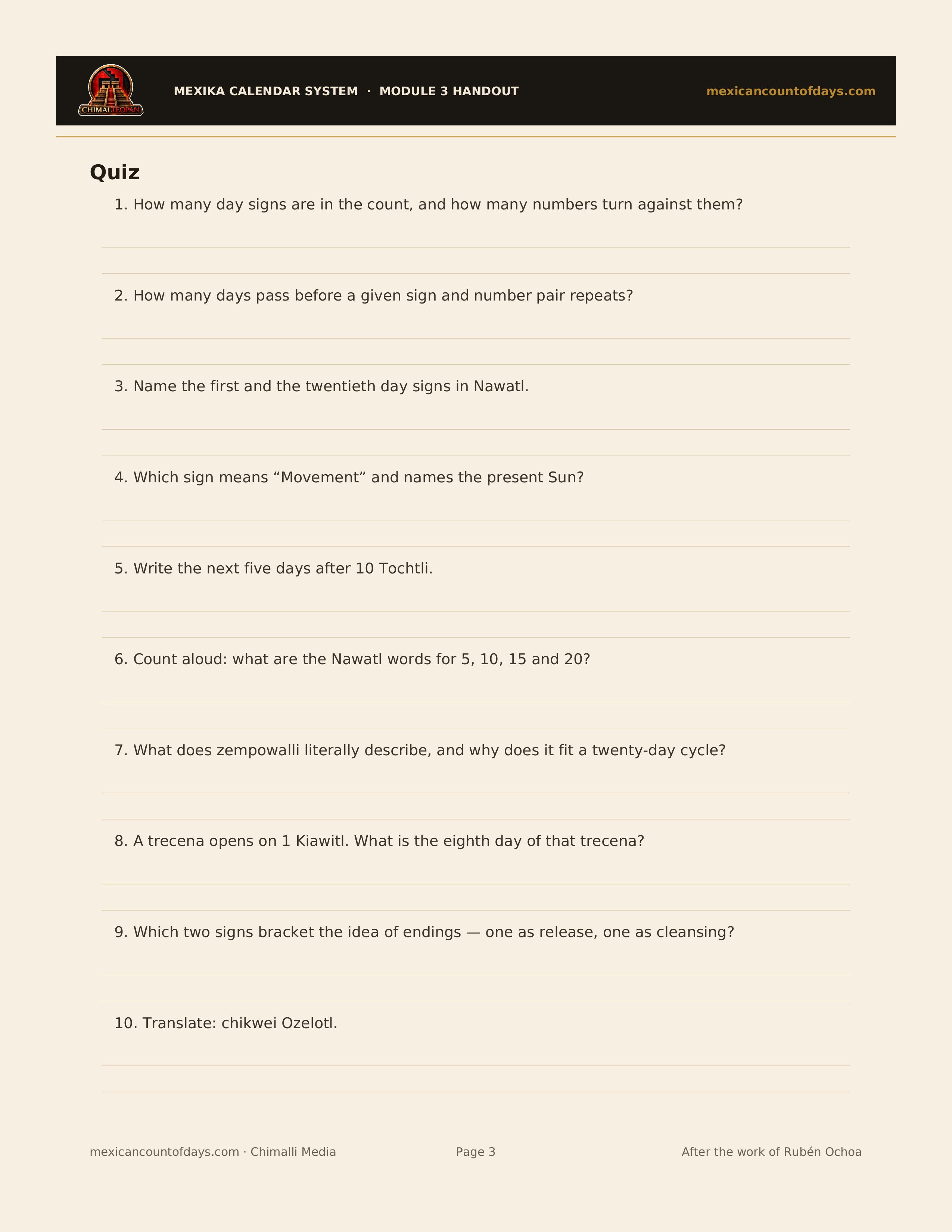
Handout: The Twenty Day Signs & Counting to Twenty in Nawatl (PDF)
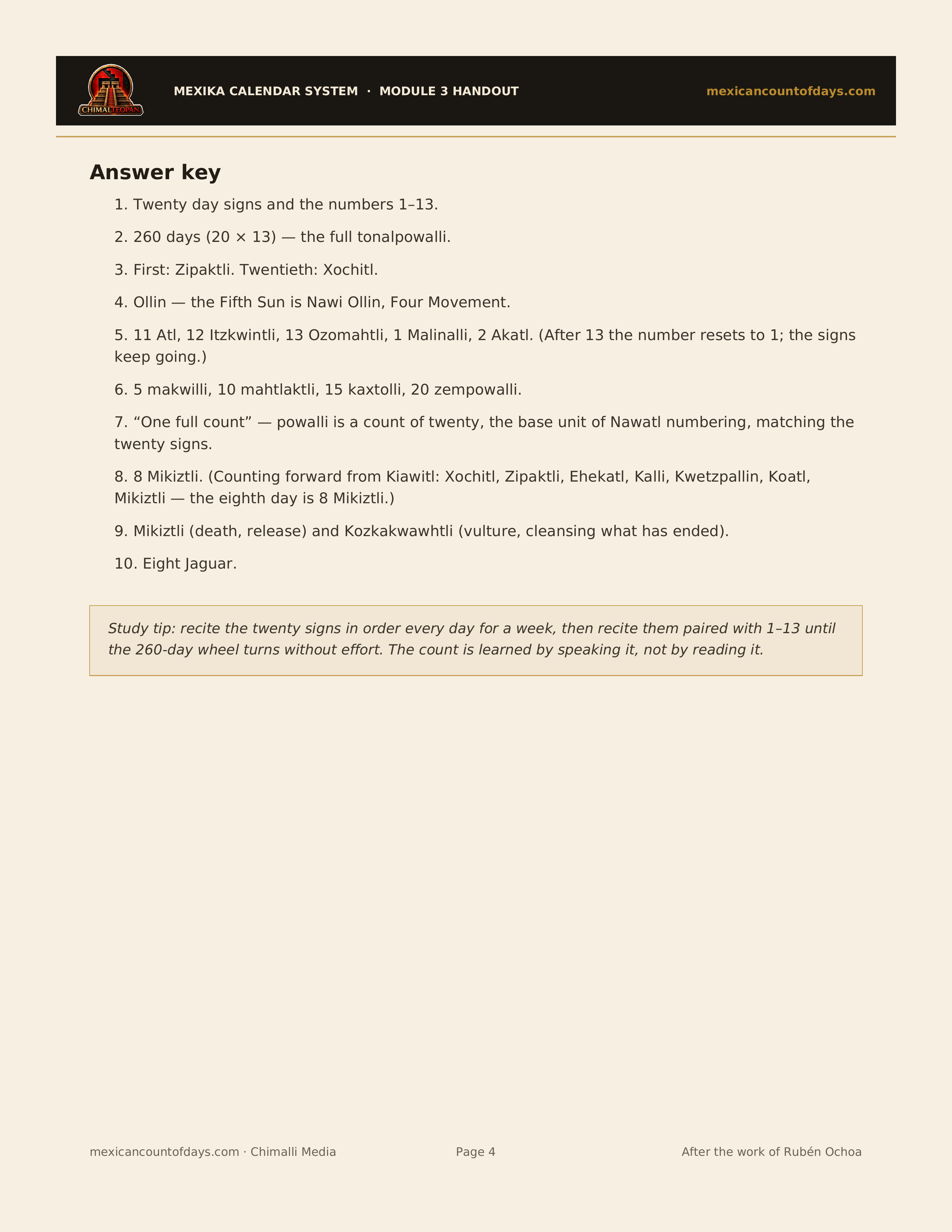
Printable reference with all twenty day signs and their meanings, the Nawatl numbers 1–20, a ten-question quiz and a full answer key.
Additional readings
Finish the readings and supplemental videos before moving to the next module.
Checkpoint
- Write out the next five days after 10 Tochtli.
- How many days pass before the same sign and number meet again?
Cumulative exam · 13 questions
Module 3 exam
This exam covers Module 3 and everything before it. You need more than 90% correct to pass.
1.The codices Borgia, Borbonicus and Telleriano-Remensis are best understood as:
2.Which of these is NOT one of the twenty day signs?
3.Which day follows 10 Tochtli?
4.How many days are in the tonalpowalli?(Module 1 review)
5.Tonalli refers to which cluster of meanings?(Module 1 review)
6.What does the orientation (azimuth) of a temple record?(Module 2 review)
7.Buildings oriented to horizon events effectively turn a city into:(Module 2 review)
8.A trecena is:
9.What does xiuhpowalli count?(Module 1 review)
10.Mesoamerican timekeeping is best described as:(Module 1 review)
11.Why does the count of days run to exactly 260?
12.What do the successive construction stages of the Templo Mayor demonstrate?(Module 2 review)
13.In a date such as 1 Kiawitl, the number gives: