Module 4 of 6
The Solar Year: Veintenas, Nemontemi and Year Bearers
The 365-day side of the system: eighteen veintenas of twenty days, the five nemontemi that close the year, the ceremonies attached to each period, and the four signs that can bear a year.
Lecture
What to take from this module
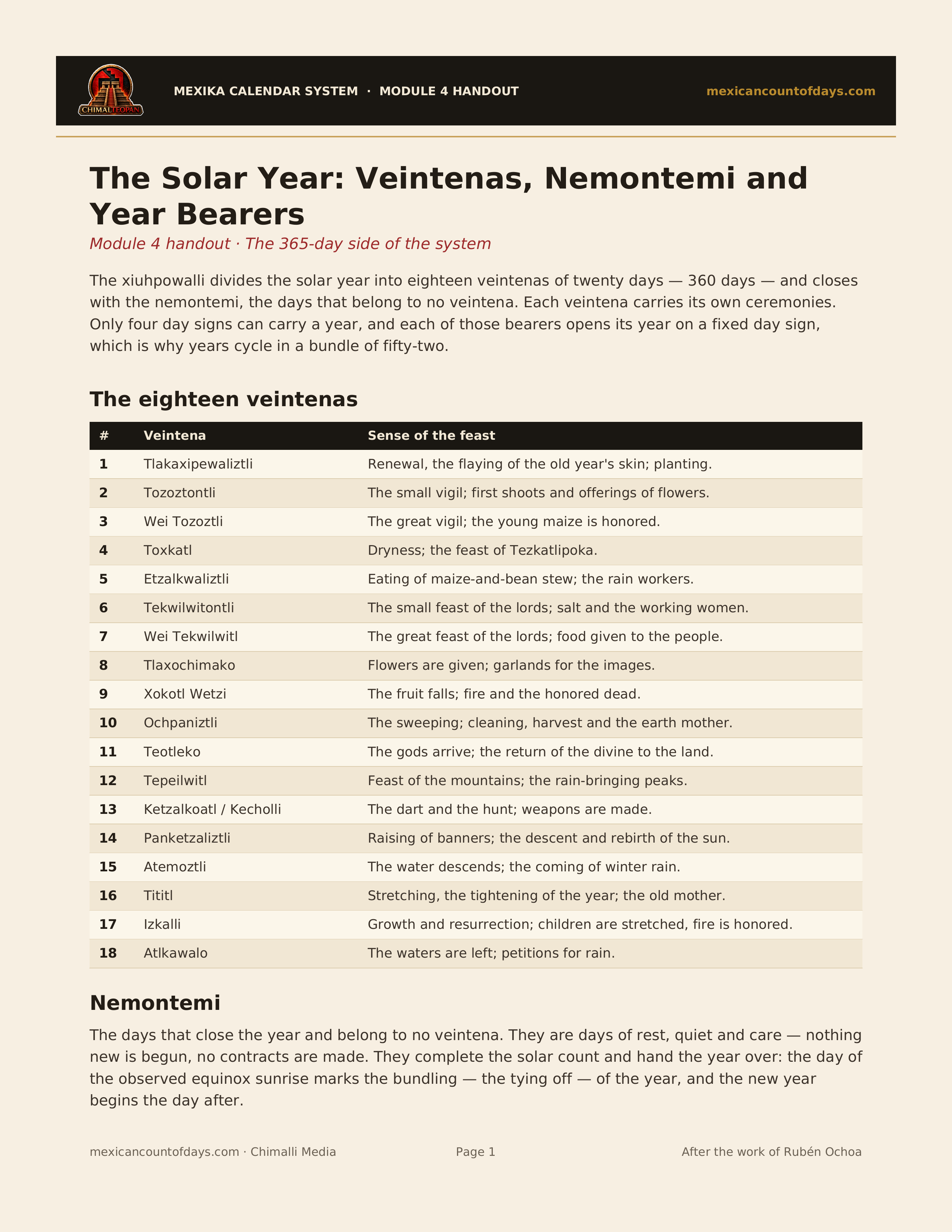
- 18 veintenas × 20 days = 360, plus nemontemi days to complete the solar year.
- Each veintena carries its own ceremonies — Mikailwitl honors the dead, Panketzaliztli the descent of the sun, and so on.
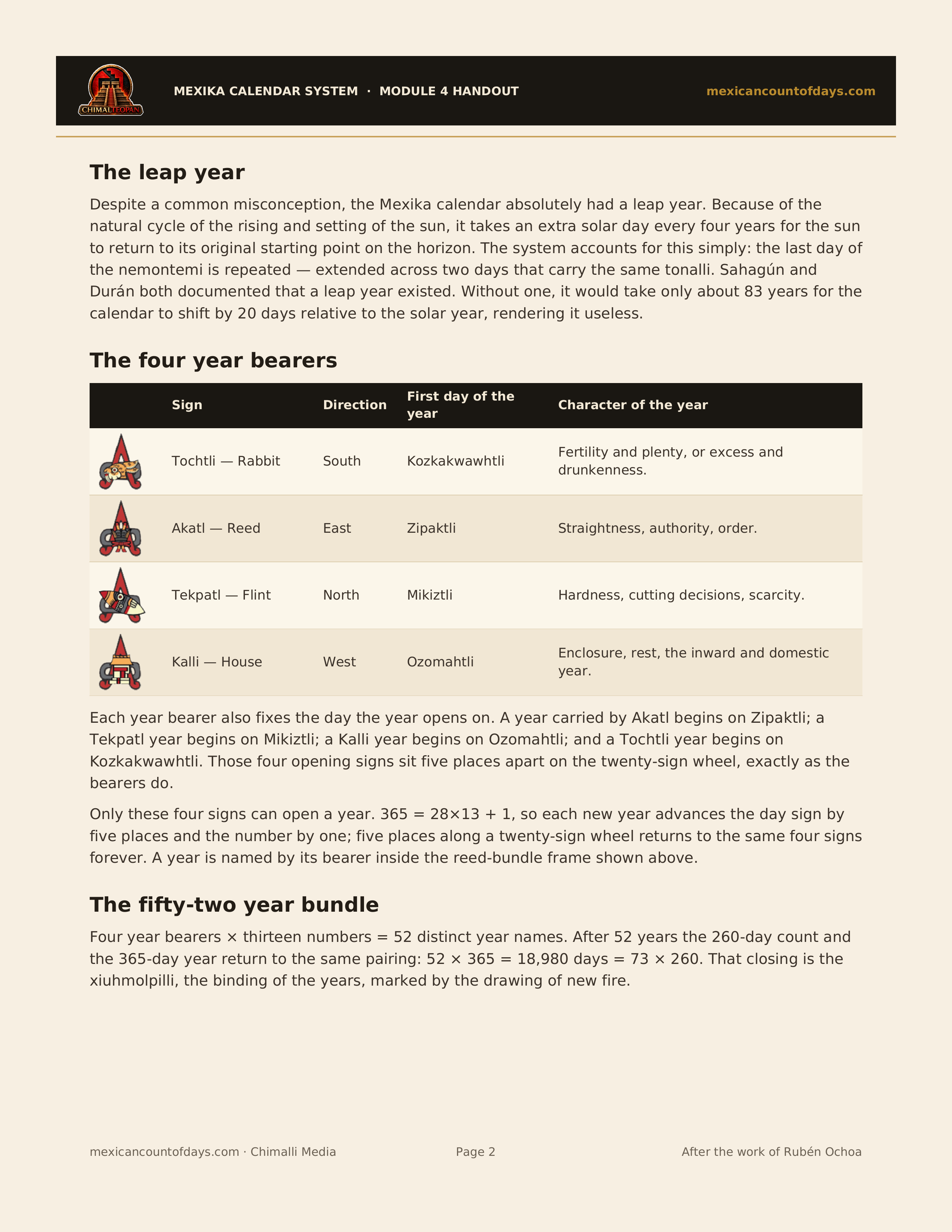
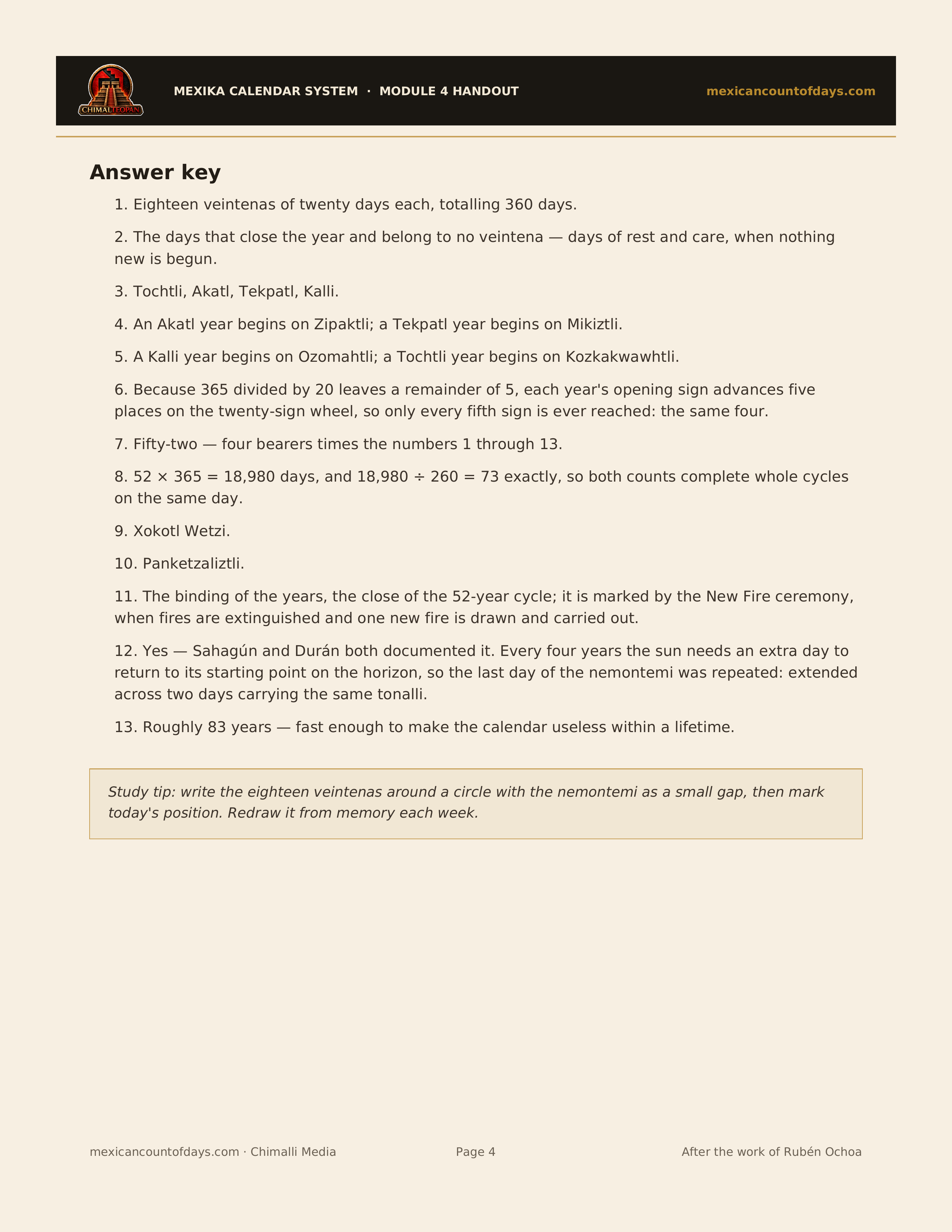
- Despite a common misconception, the Mexika calendar had a leap year: every four years the sun needs an extra day to return to its starting point on the horizon, so the last day of the nemontemi is repeated — extended across two days carrying the same tonalli. Sahagún and Durán both documented it.
- Without that correction the count would drift about 20 days against the solar year in roughly 83 years, rendering it useless.
- Only four day signs can carry a year (Tochtli, Akatl, Tekpatl, Kalli), which is why years cycle in a 52-year bundle.
- 260 and 365 come back into phase every 52 years — the xiuhmolpilli, when the new fire was drawn.
Terms introduced
- Veintena
- A twenty-day period of the solar year, each with its own feast.
- Nemontemi
- The days that close the year and belong to no veintena; days of rest and care. In leap years the last nemontemi day is extended across two days carrying the same tonalli.
- Xiuhmolpilli
- The binding of the years — the 52-year cycle ending in the New Fire ceremony.
Handout
PDF · printable
Handout: The Solar Year — Veintenas, Nemontemi and Year Bearers (PDF)
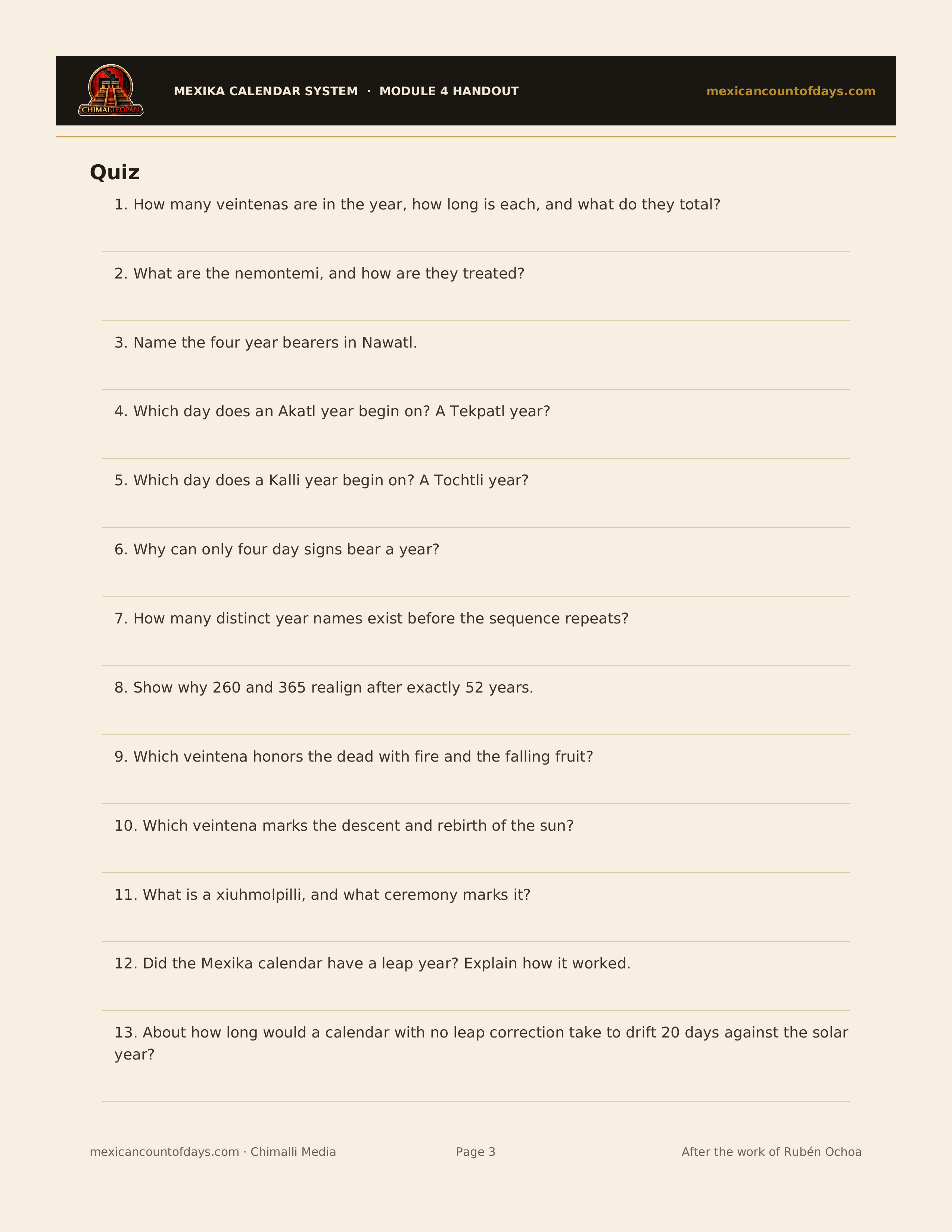
All eighteen veintenas and their feasts, the nemontemi, the four year bearers, the 52-year bundle, quiz and answer key.
Additional readings
Finish the readings and supplemental videos before moving to the next module.
Checkpoint
- Why can only four day signs bear a year?
- How did the Mexika leap year work, and which chroniclers documented it?
- Show why 260 and 365 realign after exactly 52 years.
Cumulative exam · 13 questions
Module 4 exam
This exam covers Module 4 and everything before it. You need more than 90% correct to pass.
1.The codices Borgia, Borbonicus and Telleriano-Remensis are best understood as:(Module 3 review)
2.Which veintena opens the solar year in this system?
3.Which chroniclers documented that a leap year existed?
4.Without the leap-year correction, how long until the count drifts about 20 days from the solar year?
5.Did the Mexika calendar have a leap year?
6.A trecena is:(Module 3 review)
7.The Templo Mayor of Tenochtitlan frames which event between its twin shrines?(Module 2 review)
8.Which four day signs can bear a year?
9.How many veintenas make up the solar year, and how long is each?
10.How many days are in the tonalpowalli?(Module 1 review)
11.The xiuhmolpilli is:
12.What does xiuhpowalli count?(Module 1 review)
13.What does the orientation (azimuth) of a temple record?(Module 2 review)