Module 5 of 6
Correlation: Fixing the Count to a Modern Date
The problem every student hits — which Mexika day is today? This module works through correlation, the reasoning behind Rubén Ochoa's alignment to the observed equinox sunrise at the Templo Mayor, and why competing correlations disagree.
Lecture
What to take from this module
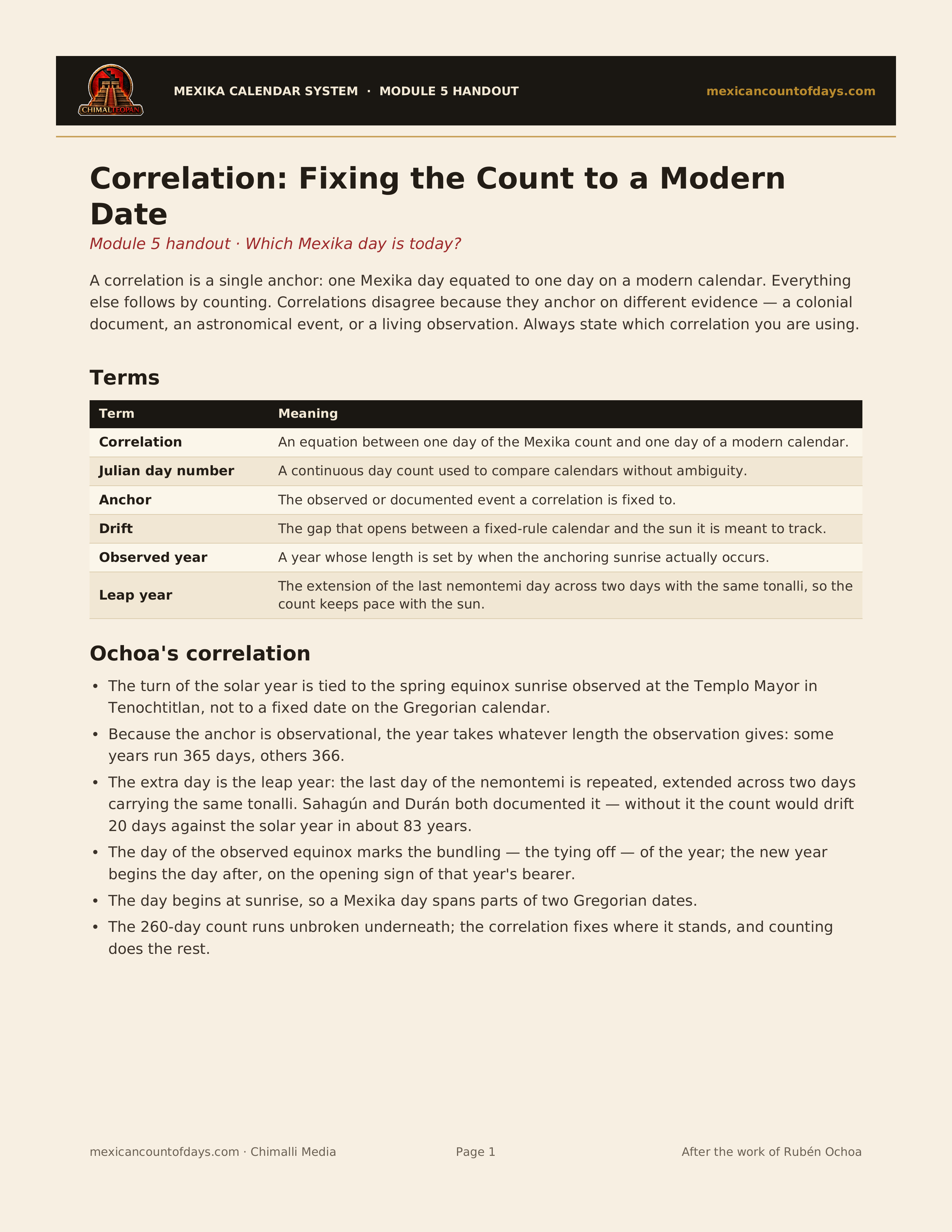
- A correlation is a single anchor: one Mexika day equated to one Julian day number. Everything else follows by counting.
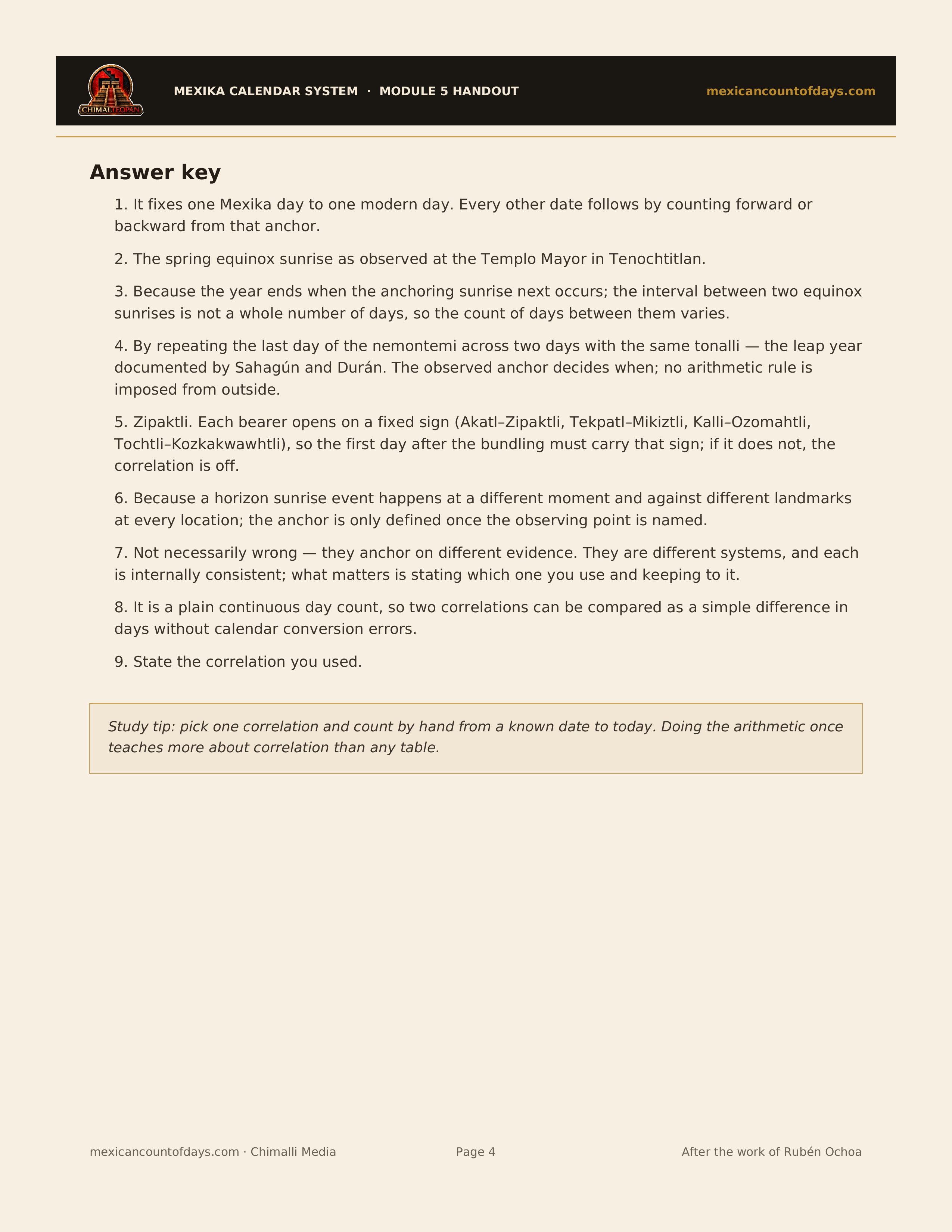
- Ochoa's correlation ties the turn of the solar year to the spring equinox sunrise as observed at Tenochtitlan's Templo Mayor, rather than to a fixed Gregorian date.
- The day of the observed equinox marks the bundling — the tying off — of the year, and the new year begins the day after.
- Every four years the sun needs an extra day to return to its original point on the horizon; the count absorbs it by repeating the last day of the nemontemi across two days with the same tonalli — the leap year documented by Sahagún and Durán. Without it, the calendar would drift 20 days in about 83 years.
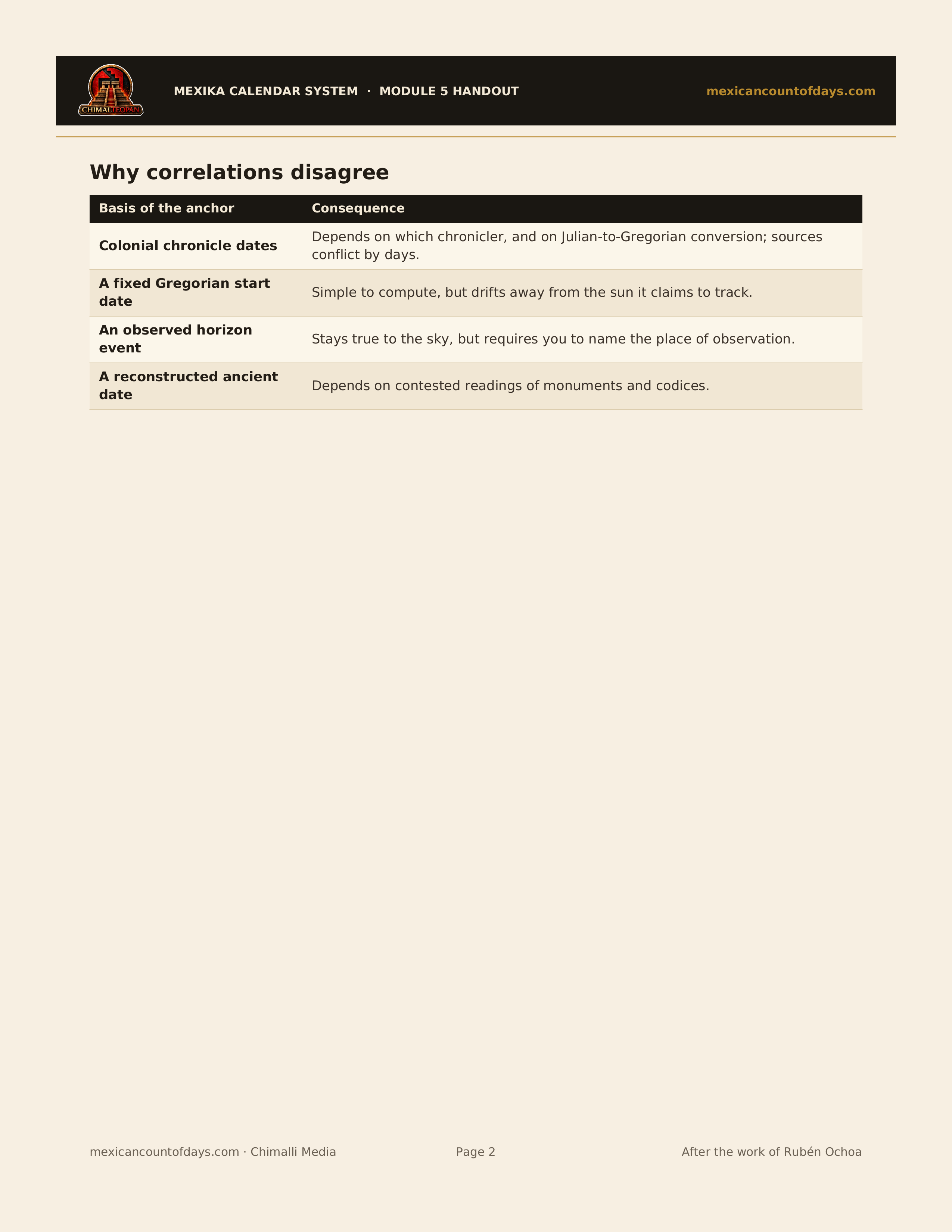
- Different published correlations shift the count by days or weeks; always state which one you are using.
Handout
PDF · printable
Handout: Correlation — Fixing the Count to a Modern Date (PDF)
Correlation vocabulary, the reasoning behind Ochoa's equinox anchor, why published correlations disagree, quiz and answer key.
Checkpoint
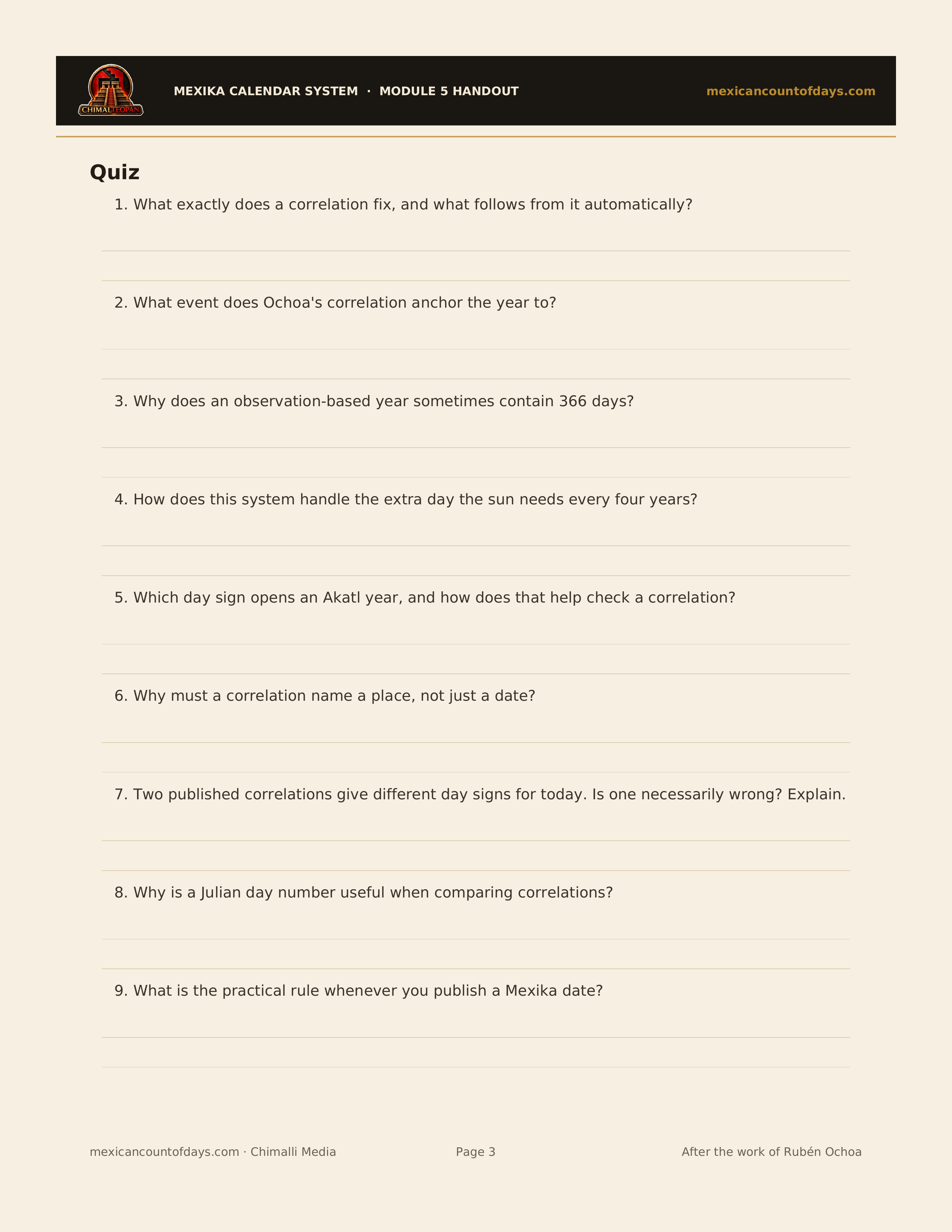
- What exactly does a correlation fix, and what follows from it automatically?
- Why does an observation-based year sometimes contain 366 days?
Cumulative exam · 13 questions
Module 5 exam
This exam covers Module 5 and everything before it. You need more than 90% correct to pass.
1.Why does an observation-based year sometimes contain 366 days?
2.What does xiuhpowalli count?(Module 1 review)
3.What exactly does a correlation fix?
4.Rubén Ochoa's correlation ties the turn of the year to:
5.A trecena is:(Module 3 review)
6.Why must you always state which correlation you are using?
7.The xiuhmolpilli is:(Module 4 review)
8.Tonalli refers to which cluster of meanings?(Module 1 review)
9.The Templo Mayor of Tenochtitlan frames which event between its twin shrines?(Module 2 review)
10.Without the leap-year correction, how long until the count drifts about 20 days from the solar year?(Module 4 review)
11.What do the successive construction stages of the Templo Mayor demonstrate?(Module 2 review)
12.Which of these is NOT one of the twenty day signs?(Module 3 review)
13.On the day of the observed equinox, what happens to the year?