Module 6 of 6
Working the Calendar: Practice and Ceremony Today
Putting the system to use — reading a date in full, tracking the year through its veintenas, keeping the new year, and treating the auguries as historical testimony rather than prescription.
Lecture
What to take from this module
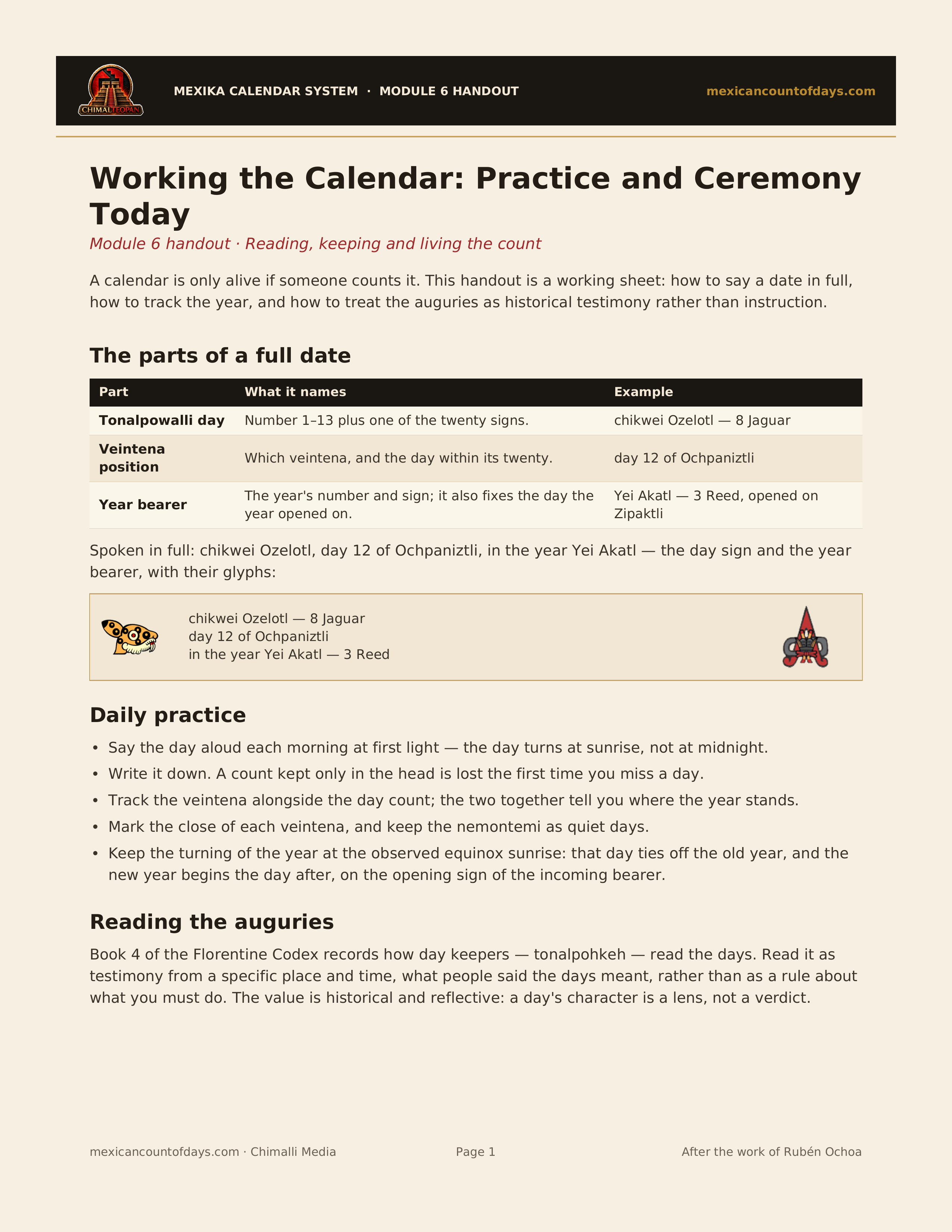
- A complete date names the day of the tonalpowalli, the position in the veintena, and the year bearer.
- Keeping the count is a daily practice: the count only stays alive if someone counts it.
- The auguries of Book 4 of the Florentine Codex record how day keepers read the days; read them as testimony from a place and time.
- The observed equinox sunrise ties off the old year; the new year begins the day after — the moment the whole system is re-anchored.
Handout
PDF · printable
Handout: Working the Calendar — Practice and Ceremony Today (PDF)
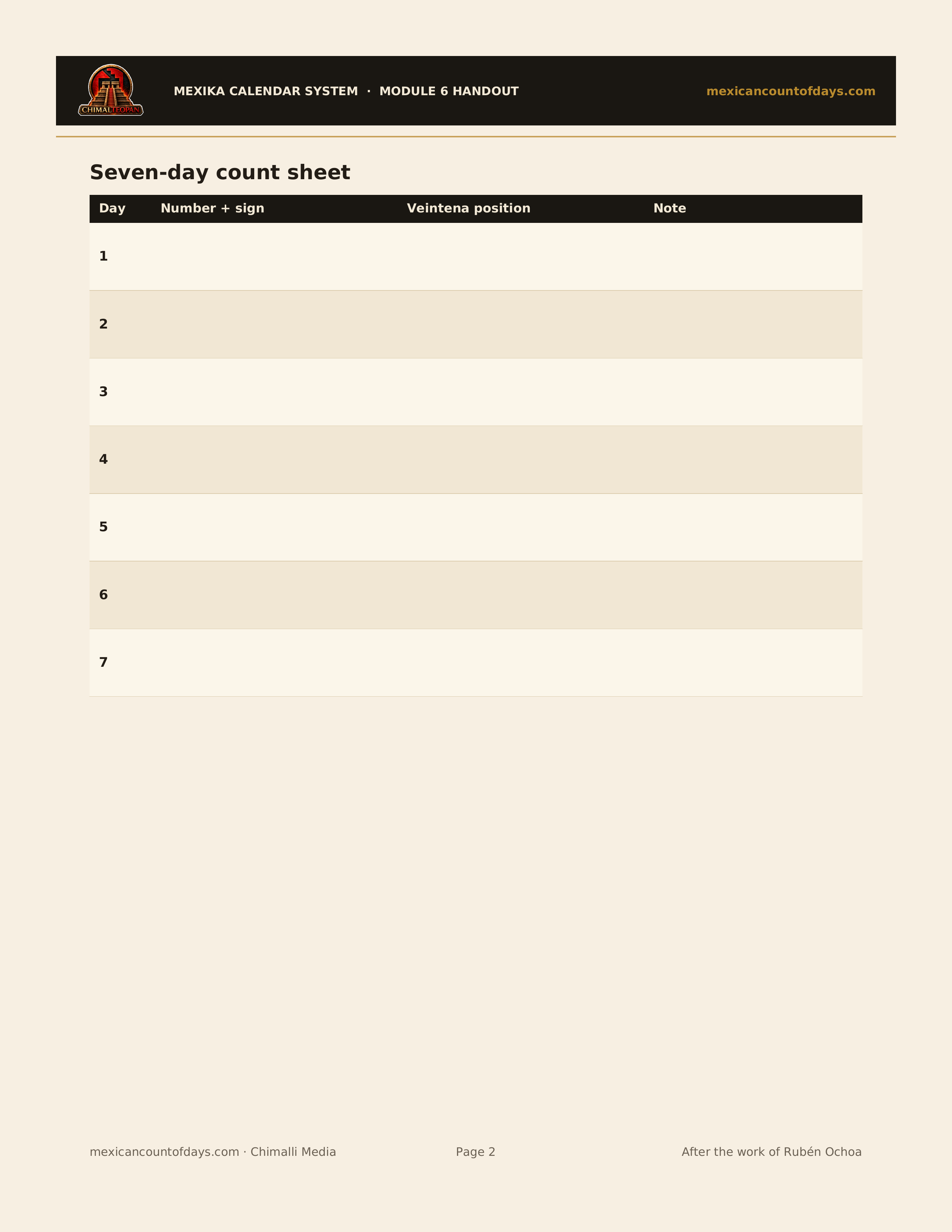
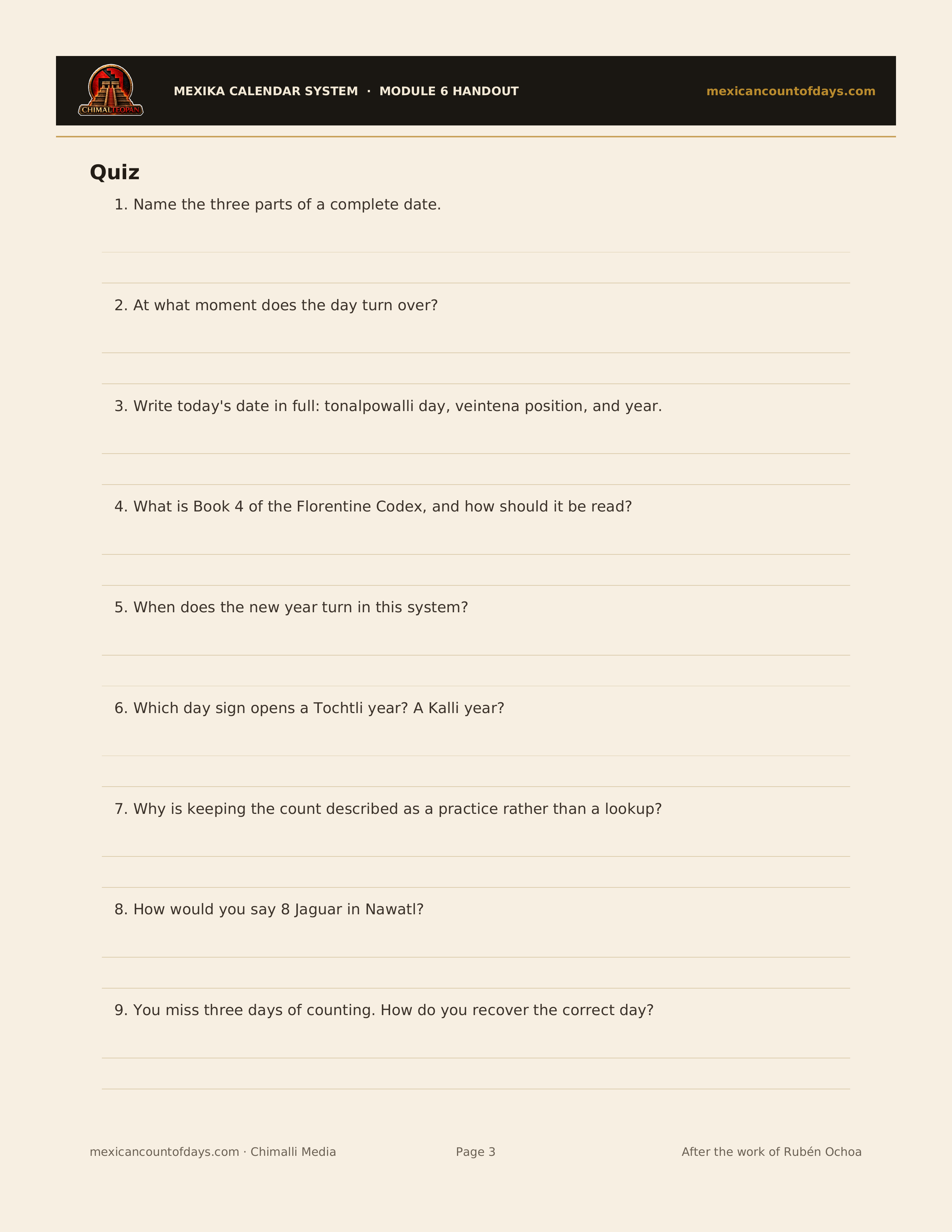
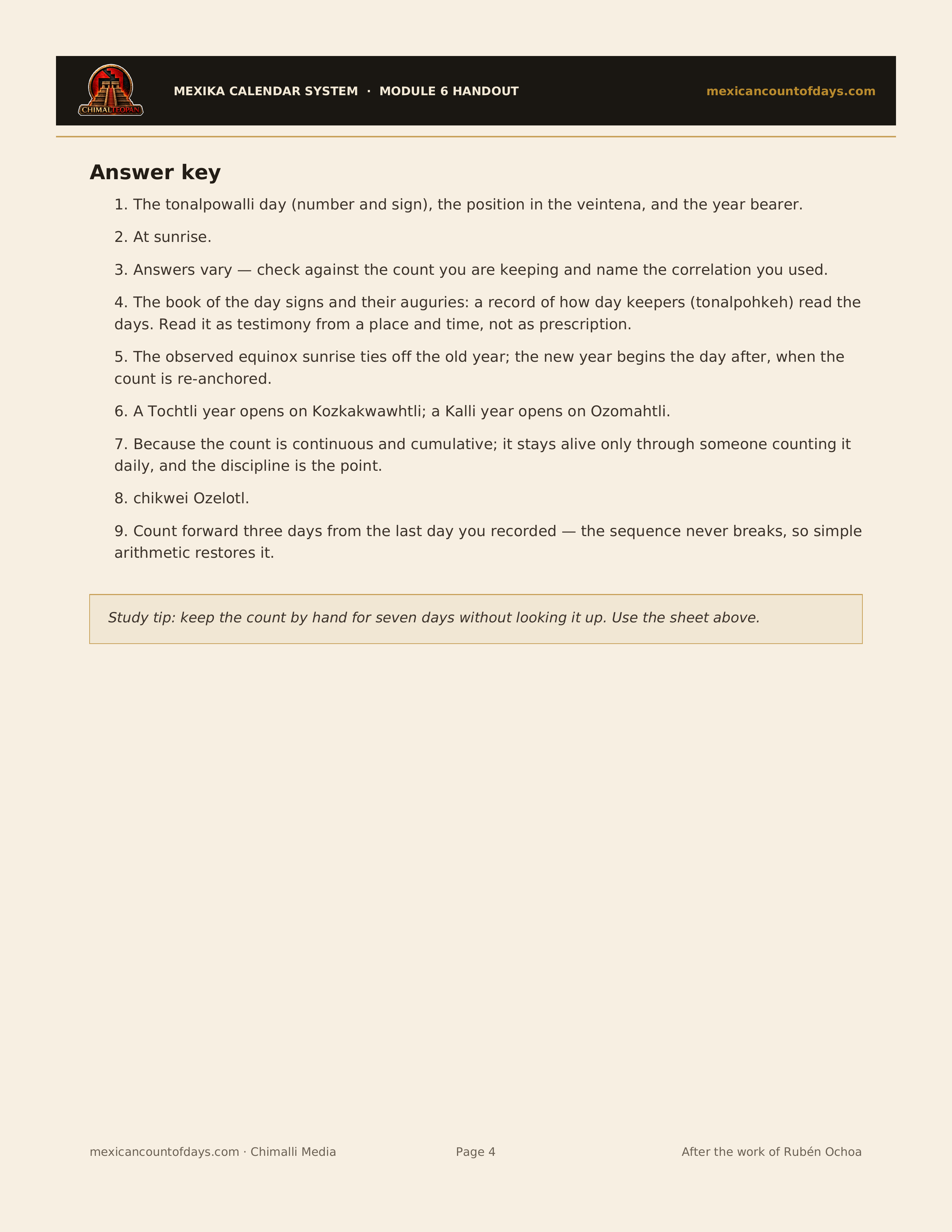
The parts of a full date, a daily practice checklist, a blank seven-day count sheet, quiz and answer key.
Additional readings
Finish the readings and supplemental videos before moving to the next module.
Checkpoint
- Write today's date in full: tonalpowalli day, veintena position, and year.
- Keep the count by hand for seven days without looking it up.
Cumulative exam · 13 questions
Module 6 exam
This exam covers Module 6 and everything before it. You need more than 90% correct to pass and unlock your certificate of completion.
1.What keeps the count alive?
2.Why does the count of days run to exactly 260?(Module 3 review)
3.Without the leap-year correction, how long until the count drifts about 20 days from the solar year?(Module 4 review)
4.What does xiuhpowalli count?(Module 1 review)
5.Which four day signs can bear a year?(Module 4 review)
6.What do the successive construction stages of the Templo Mayor demonstrate?(Module 2 review)
7.A complete Mexika date names:
8.Why is the Mexika calendar described as an observational science?(Module 1 review)
9.The auguries of Book 4 of the Florentine Codex should be read as:
10.Because the anchor is a sunrise observed at a place, the Mexika day begins:(Module 2 review)
11.On the day of the observed equinox, what happens to the year?(Module 5 review)
12.In practice, when is the whole system re-anchored each year?
13.Which day follows 10 Tochtli?(Module 3 review)